Montgomery County, Pennsylvania Property Guide 2026
Find Montgomery County PA Property Records, Calculate the Tax and Prepare an Assessment Appeal
Use this guide to search a Montgomery County parcel by street address or parcel ID, understand assessed value, identify the correct tax collector, check delinquent taxes, prepare appeal evidence and obtain recorded deeds.
“Montgomery County PA CAD” is a common search phrase, but Pennsylvania does not use a Texas-style central appraisal district. The correct assessment office is the Montgomery County Board of Assessment Appeals.
Office location
425 Swede Street, Suite 301, Norristown
Public search
Address or parcel ID
Annual appeal deadline
August 1
Quick Answer: Which Montgomery County Office Handles Your Task?
Board of Assessment Appeals
Property assessments, parcel records, tax maps, mailing-address corrections, homestead and farmstead applications, exemptions, Clean and Green matters and assessment appeals.
Local tax collector
Current annual and interim county, municipal or school real-estate tax bills, bill copies, discount dates, face periods, penalty periods and current-year payment methods.
Tax Claim Bureau
Delinquent county, municipal and school real-estate tax liens, delinquent online payments, tax certifications and tax-sale matters.
Recorder of Deeds
Recorded deeds, mortgages, satisfactions, easements, plans, powers of attorney, document copies and property-fraud alerts.
Municipality or school district
Local millage, special charges, school-tax installment rules and questions involving the taxing authority rather than the assessment.
Surveyor or title professional
Legal boundaries, title defects, easements, ownership interests, access rights and complete lien research.
Fast routing rule: Search and assessed-value questions go to the Board of Assessment Appeals. Current bills go to the local collector. Delinquent bills go to the Tax Claim Bureau.
How to Use the Montgomery County Property Records Screenshot
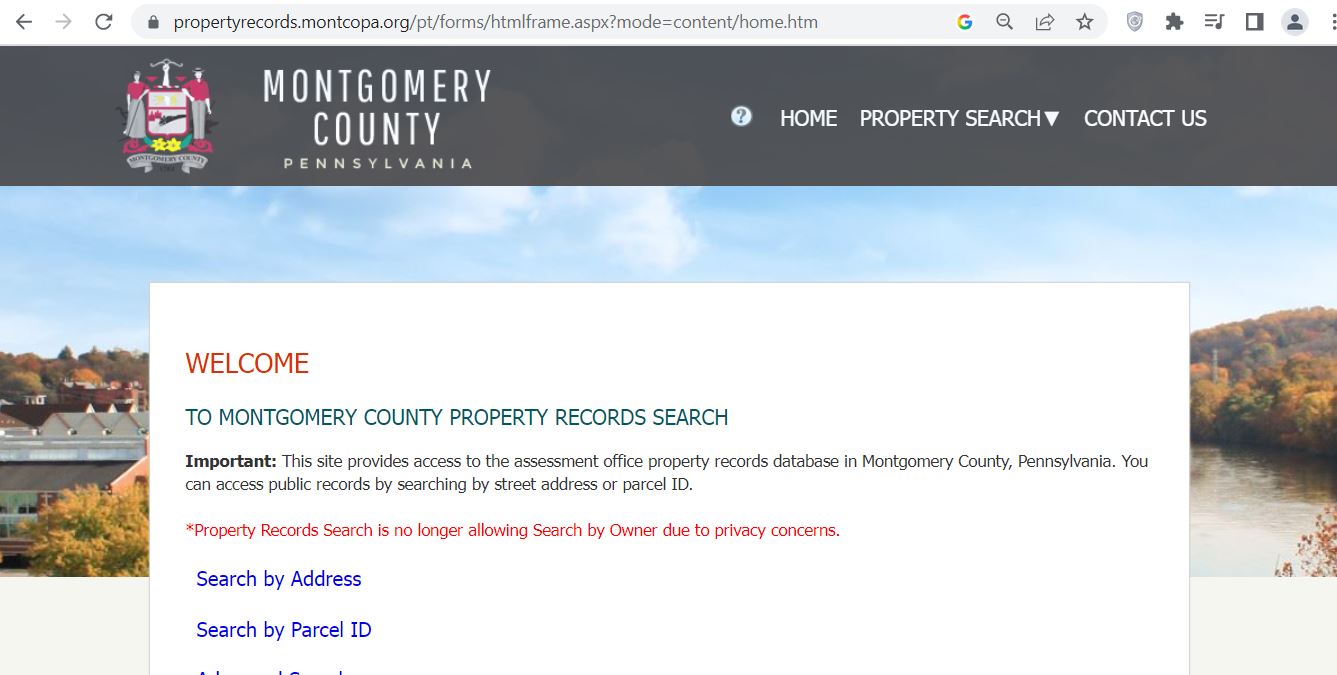
The supplied screenshot shows the official Montgomery County, Pennsylvania property-records search homepage. It is the correct database for public assessment information.
The most important message in the screenshot is the red notice explaining that public searches by owner name are no longer permitted because of privacy concerns.
Official Montgomery County property-records page showing address and parcel-ID search options and the owner-search privacy notice.
1Verify the official portal
Check that the browser address shows propertyrecords.montcopa.org.
2Do not look for owner search
The county states that owner-name searching is no longer available in this assessment portal.
3Select Search by Address
Use this when you know the property’s physical street address but do not have the parcel number.
4Select Search by Parcel ID
This is usually the most precise route. Find the parcel ID on a tax bill, assessment notice, deed paperwork or prior property record.
5Use Property Search navigation
The top menu can reopen the available search types if you move away from the welcome page.
6Use recorded deeds for name research
When only an owner’s name is known, begin with the Recorder of Deeds and obtain the parcel or address from the recorded document.
Best route from the screenshot: Click Search by Parcel ID when possible. It avoids confusion between similar street names, unit numbers and properties in different municipalities.
How to Search Montgomery County PA Property Records
Choose parcel ID when available.
Copy the full parcel number from the tax bill or assessment notice. Do not omit leading zeros or separators unless the search instructions require it.
Otherwise choose street-address search.
Enter the physical property address rather than the owner’s mailing address.
Begin with a simple address.
Use the house number and main street name. Remove apartment wording, punctuation, directional letters and street suffixes if no result appears.
Confirm the municipality.
A postal city does not always identify the legal township or borough used for assessment and taxation.
Open every plausible result.
A condominium, commercial complex, apartment building or multi-parcel property can have several separate parcel IDs.
Match the parcel, address and taxing districts.
Confirm the parcel ID, physical location, municipality and school district before using the record.
Review the complete record.
Check assessment, estimated market value, land and improvement information, homestead status and available tax-map information.
Save a dated copy.
Print or save the record before requesting a correction, appealing, paying taxes or purchasing the property.
Local address tip: Montgomery County has 62 municipalities and many duplicate street names. Always verify the township or borough rather than relying only on the postal city.
Property Search Problems and Practical Fixes
Problem
What to Try
Next Check
Owner-name search is unavailable
Use the Recorder of Deeds Public Access System to search the name.
Open the deed and copy its parcel ID or street address.
Full address returns nothing
Remove Street, Avenue, Road, directional wording, unit number and punctuation.
Confirm whether the physical address differs from the mailing address.
Several similar addresses appear
Compare municipality, school district and parcel ID.
Use the tax bill or deed to identify the exact parcel.
Condominium unit is missing
Search the building address without the unit, then review separate unit records.
Match the unit designation and parcel number in the recorded deed.
Recent buyer is not reflected
Search the address or parcel instead of the buyer’s name.
Review the newest deed in the Recorder of Deeds system.
Mailing address is incorrect
Use the county’s official mailing-address change form.
Submit it early enough for the next tax-bill production cycle.
Parcel line looks wrong
Compare the GIS layer with the deed, plan and professional survey.
Do not request a legal boundary decision from an assessment-map screenshot.
Property still cannot be found
Call the Board of Assessment Appeals at 610-278-3761.
Provide the street address, municipality and any parcel or deed information available.
“I am trying to identify the correct Montgomery County assessment parcel. The physical address is ______, the municipality may be ______, and my tax or deed paperwork shows ______. Can you help me confirm the complete parcel ID?”
How to Read a Montgomery County Property Record
Record Field
Plain-English Meaning
What to Verify
Parcel ID
The county’s unique assessment identifier for the property.
Use the complete number on appeal forms, tax inquiries and deed searches.
Property address
The physical location associated with the assessment parcel.
Do not confuse it with the owner’s mailing address.
Municipality
The legal township or borough containing the parcel.
This determines the local collector and municipal tax rate.
School district
The school taxing authority assigned to the parcel.
School taxes can represent a major portion of the total property-tax bill.
Land assessment
The assessed amount assigned to the land component.
Lot size, land use, location and any separate adjoining parcel.
Improvement assessment
The assessed amount assigned to buildings or structures.
Building use, size, age, construction and condition.
Total assessment
The assessment used as the starting point for real-estate tax calculation.
Use this figure—not a consumer website estimate—in the tax formula.
Estimated market value
An estimate derived from assessment-system equalization information.
It is not necessarily a current appraisal or guaranteed sale price.
Homestead status
Whether the parcel has been approved for applicable homestead treatment.
Approval does not mean every taxing authority grants the same dollar reduction.
Tax map or GIS information
General parcel-location and mapping data.
It is not a legal survey or title opinion.
Legal-record warning: The assessment database helps with tax research. It does not replace the recorded deed, title examination, municipal zoning confirmation or professional boundary survey.
Assessed Value, Market Value and the Common Level Ratio
Montgomery County uses a base-year assessment system. The assessed value shown in the county record is not the same as the amount a property would necessarily sell for in 2026.
Assessed value
The amount multiplied by each taxing authority’s millage to calculate real-estate tax.
Current market evidence
Recent arm’s-length sales, appraisals, property condition and income information used to support an appeal.
Common Level Ratio
A state equalization measure comparing assessed values with current sale prices. It can be relevant in assessment and transfer-tax contexts.
2026 factor caution: Pennsylvania’s published Montgomery County realty-transfer-tax factor is 3.36 for documents accepted from July 1, 2026 through June 30, 2027. It is not a millage rate, tax-payment multiplier or automatic appeal result.
Questions to Ask When the Assessment Changed
Was a new building or addition added?
Did the property split or combine parcels?
Was a prior exemption removed?
Did the use change from residential to commercial?
Was an interim assessment issued after construction?
Does the record contain incorrect building information?
Was a preferential assessment removed?
Does the assessment notice identify a specific reason?
How Montgomery County PA Property Tax Is Calculated
Each taxing authority applies its own millage to the county assessment. One mill equals $1 of tax for each $1,000 of assessed value.
1. Find assessed value
Example: $170,000
2. Find millage
Example county and college total: 5.952 mills
3. Multiply
$170,000 × 5.952
4. Divide by 1,000
County and college example: $1,011.84
2026 county rates: Montgomery County’s adopted 2026 budget lists 5.462 mills for the county general fund and 0.49 mills for Montgomery County Community College, for a combined county-and-college total of 5.952 mills.
This is not the full tax bill. Municipal and school-district millage must also be added. Some properties can have special district charges or separate fees.
“My parcel assessment is ______. Please confirm the 2026 county, municipal and school millage assigned to this parcel and whether the bill contains any separate fees or exclusions.”
How to Find and Pay a Current Montgomery County Real-Estate Tax Bill
Montgomery County does not use one countywide online checkout for every current property-tax bill. Annual and interim bills are mailed and collected by 62 local tax collectors.
Find the parcel and municipality.
Search the county assessment record and save the parcel ID, municipality and school district.
Select the current Tax Collectors listing.
Locate the collector serving the parcel’s township or borough.
Confirm which bill the collector handles.
Ask whether the office collects county, municipal, school or interim taxes for the property.
Request a duplicate bill when needed.
Give the parcel ID, physical address, owner information and tax year.
Read the bill’s three payment periods.
Identify the discount amount, face amount and penalty amount together with the controlling dates.
Use only the collector’s approved payment route.
Payment options differ by municipality and may include mail, office hours, drop box, e-check or card.
Save proof and verify posting.
Keep the receipt, check image or electronic confirmation associated with the correct parcel and year.
Common county pattern: County tax information describes a 2% discount period, a face-value period and a later 10% penalty period. The exact dates printed on the property’s official bill control.
Do not send current taxes to the Tax Claim Bureau unless directed. The bureau generally handles taxes after they become delinquent or when it has been appointed as third-party collector.
How to File a Montgomery County Assessment Appeal in 2026
ANNUALAUG 1DEADLINE
Important July 2026 action:
The official 2026 appeal form lists August 1 as the annual appeal deadline. Appeals must be postmarked or delivered by the applicable deadline. Faxed and emailed appeal forms are not accepted.
Calendar warning: August 1, 2026 falls on a Saturday. Mail the packet early with reliable postmark evidence or contact the office before the deadline about accepted hand-delivery timing. Do not assume an automatic extension.
Enter the complete parcel number.
Copy it directly from the official property record, tax bill or assessment notice.
Enter your opinion of value.
The form asks for the amount the owner believes represents the appropriate value.
Explain the reason for appeal.
Identify market value, incorrect property facts, unequal treatment, classification or another supported assessment issue.
Attach the assessment notice when applicable.
If appealing a specific assessment notice, check the applicable box and include the notice.
Prepare three copies of supporting evidence.
The county requires three copies of supporting documentation with the appeal packet.
Include the correct processing fee.
Pay by check or money order to the Montgomery County Treasurer. The fee applies separately to each appealed parcel.
Obtain the original authorized signature.
The owner or authorized business representative must provide the required original signature. Attorney signatures may follow the rules stated on the form.
Mail or hand-deliver the packet.
Do not rely on ordinary email or fax. Save proof showing the mailing or delivery date.
Monitor the hearing notice.
Note any unavailable hearing dates on the appeal form and prepare for a hearing that may be scheduled months later.
Nonrefundable
Fees are payable by check or money order
Notice-based appeal warning: A new or changed assessment notice can contain a separate filing deadline. Follow the notice and contact the Board rather than assuming every appeal waits until August 1.
Build an Appeal Packet That Answers the Board’s Real Question
The Board needs evidence supporting the owner’s requested value or correction. A complaint about the size of the tax bill does not prove that the assessment is wrong.
Appeal Issue
Useful Evidence
Weak Approach to Avoid
Market value is excessive
Recent appraisal, arm’s-length comparable sales, condition evidence and repair estimates.
Only stating that the taxes are unaffordable.
Building data is wrong
Measurements, plans, permit records and dated photographs.
An unsupported estimate of size or condition.
Property has major damage
Inspection reports, contractor estimates, insurance documents and photographs.
Photos that do not show date, room or repair scope.
Commercial value is high
Income statements, rent rolls, operating expenses, vacancy and capitalization support.
Submitting no financial evidence.
Land value is high
Comparable land sales, access limits, easements, topography, utilities and development restrictions.
Comparing the parcel with dissimilar land in another municipality.
Assessment is not uniform
Comparable assessments adjusted for use, size, age, condition and location.
Selecting one unusually low neighboring assessment.
Appeal Evidence Checklist
Completed 2026 appeal form
Original authorized signature
Correct processing-fee check
Three complete evidence copies
Property-record printout
Assessment notice when applicable
Owner’s supported opinion of value
Comparable-sales table
Recent professional appraisal when available
Dated property photographs
Repair or remediation estimates
Income and expense records for income property
Supplemental evidence timing: The county says additional supporting documentation should reach the Board at least 10 days before the scheduled hearing.
Hearing schedule: The Board notes that appeals filed early can wait several months for a hearing and that annual appeals must generally be heard by October 31. Rescheduling near the deadline is limited to extraordinary circumstances.
“I am appealing parcel ______. My opinion of value is $______. My evidence consists of comparable sales, property-condition photographs and repair estimates showing why the current assessment does not reflect the property.”
What to Do When the Appeal Deadline Has Passed
Missing the annual deadline usually means the owner cannot simply file the same appeal late. The available route depends on whether the issue involves a new notice, clerical error, exemption denial or another appealable decision.
Recent assessment notice
Read the notice immediately. A notice-based appeal may use its own deadline rather than the annual August 1 date.
Incorrect property facts
Document the error and ask whether an administrative correction or assessment-change process is available.
Homestead denial
The county’s homestead/farmstead denial appeal form states a 40-day filing period from the denial notice.
Board decision already issued
Review the decision immediately for the Court of Common Pleas appeal deadline and filing instructions.
Current tax bill is due
Contact the collector. An assessment dispute does not automatically suspend payment deadlines.
Taxes are delinquent
Contact the Tax Claim Bureau separately to prevent additional costs or tax-sale exposure.
Do not delay while collecting perfect evidence. First identify and protect the filing deadline. Evidence can be organized according to the Board’s supplemental-document rules.
Montgomery County Homestead and Farmstead Exclusion
The homestead or farmstead exclusion reduces the assessed value used by a participating taxing authority. It does not erase the county assessment or guarantee the same reduction from every tax bill.
Homestead property
The property must be the owner-applicant’s primary residence. A person cannot claim a similar primary-residence benefit in another state or county.
Farmstead property
The farmstead section applies to qualifying buildings and structures used for commercial agricultural production on eligible farmland.
Application office
Submit the application to the Montgomery County Board of Assessment Appeals, not directly to every school district.
Homestead Application Micro-Steps
Confirm the parcel number.
Search the property database or copy the parcel ID from the tax bill.
Enter the municipality and school district.
Verify both in the official assessment record.
Answer mixed-use questions accurately.
Report rental, business or home-office use when requested.
Complete farmstead questions only when applicable.
Be prepared to document commercial agricultural use of the buildings or structures.
Sign as a qualifying owner-occupant.
The form must be signed by an owner for whom the property is the primary residence.
File by the applicable deadline.
Act 1 school-district applications are due by March 1. County guidance states that owners seeking both Act 1 and a locally adopted Act 50 program should file by December 15.
Verify receipt and approval.
Call 610-278-3761 or use the contact information on the Board’s official page.
Change-in-use rule: The county application states that an approved owner must notify the Assessment Office within 45 days when the property’s use changes so that it may no longer qualify.
Homestead-denial appeal: File the separate appeal within 40 days of the denial notice. That hearing is limited to homestead or farmstead eligibility and cannot be used to challenge the property’s value.
Clean and Green Preferential Assessment
Pennsylvania’s Clean and Green program can assess qualifying agricultural, agricultural-reserve or forest-reserve land according to use value rather than unrestricted market value.
Identify every parcel
A farm or woodland operation can include several separately assessed parcels. List each parcel involved.
Document current use
Prepare acreage, agricultural production, forest use, lease and land-management information.
Understand rollback exposure
A change to an ineligible use can produce rollback taxes, interest and other consequences.
Parcel ID for each tract
Current deed and legal description
Total acreage and use breakdown
Agricultural-production records
Forest-management information
Lease documents when applicable
Map showing each use area
Explanation of any subdivision or proposed change
County fee: Montgomery County lists a $50 processing fee per parcel for new or amended preferential-assessment applications and a $50 appeal fee for preferentially assessed property.
Before changing use: Contact the Board of Assessment Appeals before subdividing, developing, separating a homesite or ending the qualifying use.
How to Search and Pay Delinquent Montgomery County Property Taxes
The Montgomery County Tax Claim Bureau accepts delinquent real-estate tax liens for county, municipal and school districts for which it is the appointed collector.
Select Delinquent Property Search and Online Payment.
Use the official service rather than an advertisement or third-party property website.
Search the correct parcel.
Use the county parcel ID and property address from the assessment record.
Review each taxing authority and year.
Confirm whether the lien includes county, municipal, school or multiple-year balances.
Check the corrected breakdown.
The bureau advises users to rely on its delinquent search when a mailed breakdown appears misaligned.
Request an exact payoff when necessary.
Tax-sale, closing, refinance and reinstatement situations may require a current certification or verified payoff.
Use the authorized payment method.
Review all online or office instructions before authorizing payment.
Save proof and confirm release.
Keep the confirmation and follow up when a lien release or closing document is required.
2026 Montgomery County Tax-Sale Dates
August 20, 2026
Judicial Sale
September 24, 2026
Upset Sale
December 10, 2026
Continued Judicial Sale
December 10, 2026
Continued Upset Sale
Tax-sale warning: An upset-sale purchaser can take the property subject to liens and encumbrances. Never bid without independent title research and professional advice.
Act 57 Penalty-Waiver Route
Act 57 can allow waiver of certain additional charges after a qualifying event, such as specified ownership-transfer or notice circumstances. The county requires a completed application, supporting documents and full payment of the tax’s face amount.
Where to submit: Send an Act 57 request to the current collector during the current year. After delinquency, submit it to the delinquent collector. The county warns that applications filed more than 12 months after a qualifying event can lose eligibility.
How to Search Montgomery County Deeds, Mortgages and Liens
The Recorder of Deeds maintains the county’s recorded land documents. Unlike the assessment portal, its Public Access System supports searches using criteria that can include names, addresses and parcel IDs.
Create or access the search account when required.
Follow the portal’s registration and login instructions.
Search the owner as grantor and grantee.
The grantor generally transfers an interest; the grantee generally receives it.
Try all relevant name forms.
Search former names, initials, trusts, estates and business entities separately.
Use the parcel ID whenever available.
It helps separate records involving common names or similar addresses.
Open the underlying document.
Match the property description, recording date, instrument information and parties.
Search related mortgages and satisfactions.
Finding the deed alone does not establish that every lien has been released.
Use professional title research for a transaction.
The public portal is a research tool, not title insurance or a legal opinion.
Free fraud alert: Property owners can configure FraudSleuth through the Recorder’s Public Access System. The county recommends using the unique parcel identification number in the alert profile.
Name-change warning: Adding, removing or changing a person on a deed generally requires preparation and recording of a new deed. It is not completed by editing the assessment record.
Montgomery County GIS and Parcel-Map Research
The county provides public GIS data, parcel layers and map applications. These tools are helpful for geographic research, nearby parcels and data downloads.
Find the assessment parcel first.
Copy the parcel ID, municipality and address from the property record.
Select an appropriate viewer or dataset.
Choose parcel, aerial, road or other authoritative county layers relevant to the task.
Match the parcel ID.
Confirm that the selected polygon corresponds with the assessment record.
Review surrounding geography.
Note adjoining parcels, roads, waterways and municipal boundaries.
Verify specialized issues elsewhere.
Confirm zoning with the municipality, flood information with the responsible flood source and boundaries with a surveyor.
Do not build from a GIS line. County parcel layers are public geographic resources and should not be treated as a legal boundary survey.
Practical Montgomery County Property Scenarios
Norristown property
Verify the municipality, school district, parcel ID, assessment, current collector and whether taxes have transferred to Tax Claim.
Lower Merion residence
Review separate county, township and school bills and confirm homestead approval rather than comparing only one bill.
King of Prussia commercial property
Prepare income, expense, vacancy and lease information before appealing an income-producing assessment.
Pottstown multi-unit property
Confirm the building use, unit count, assessment classification and multi-family appeal fee.
Lansdale-area condominium
Match the exact unit parcel. The building address alone can lead to another owner’s record.
Upper-county farm or woodland
Review Clean and Green status, every included parcel and rollback consequences before changing use.
Property Buyer and New-Owner Checklist
Assessment review
Correct parcel ID
Municipality and school district
Land and improvement assessment
Estimated market value
Homestead status
Pending assessment appeal
Tax review
County and municipal bill
School tax bill
Interim tax bills
Delinquent Tax Claim balance
Payment receipts
Act 57 eligibility issue
Recorded and land records
Current deed
Mortgages and satisfactions
Liens and judgments
Easements and plans
Zoning and permits
Survey and legal access
Purchase-year warning: Do not estimate future taxes only from the seller’s current bill. A homestead exclusion, preferential assessment, pending appeal or interim assessment can change the buyer’s tax position.
Montgomery County Property Office Contacts
Assessments and appealsBoard of Assessment Appeals
One Montgomery Plaza, Suite 301
425 Swede Street
Norristown, PA 19401
Mailing address:
Montgomery County Courthouse
P.O. Box 311
Norristown, PA 19404-0311
Before visiting: Confirm current building access, holiday closures, delivery instructions, accepted payment type and whether an appointment is required for your task.
Montgomery County Board of Assessment Appeals Map
Use this map for directions to One Montgomery Plaza at 425 Swede Street in Norristown.
Return to live official records
Use the responsible government portal whenever you need a current assessment, deadline, collector, balance, deed or filing status.
Montgomery County PA Property Tax Search FAQs
1. Does Montgomery County, Pennsylvania have a central appraisal district?
No. “Montgomery County PA CAD” is a common search phrase, but assessment records and appeals are handled by the Montgomery County Board of Assessment Appeals.
2. Where do I search Montgomery County PA property records?
Use the official property-records portal at propertyrecords.montcopa.org. Public assessment searches are available by street address or parcel ID.
3. Can I search the Montgomery County assessment portal by owner name?
No. The county states that owner-name searching is no longer permitted in the property-records portal because of privacy concerns. Use an address or parcel ID, or search recorded deeds when only a name is known.
4. What is the Montgomery County Board of Assessment Appeals phone number?
The assessment and appeals office can be reached at 610-278-3761. Its office is at One Montgomery Plaza, Suite 301, 425 Swede Street in Norristown.
5. What is the 2026 Montgomery County assessment-appeal deadline?
The official 2026 annual appeal form lists August 1 as the annual deadline. A specific assessment notice can have a separate controlling deadline, so read the notice carefully.
6. Can I email or fax a Montgomery County assessment appeal?
No. The official 2026 instructions state that appeals must be mailed or hand-delivered and that faxed or emailed appeals are not accepted.
7. How much does a Montgomery County assessment appeal cost?
The county lists $50 for a single-family residential parcel, $100 for residential multi-family property, $200 for commercial or industrial property and $50 for preferentially assessed property. Separate fee rules apply to exemption matters.
8. Where do I pay current Montgomery County property taxes?
Current annual and interim real-estate bills are collected by local tax collectors serving the county’s municipalities. Use the official county Real Estate Tax page to locate the correct collector.
9. Where do I pay delinquent Montgomery County property taxes?
Use the Montgomery County Tax Claim Bureau’s official delinquent-property search and payment service. Confirm every tax year and taxing authority before paying.
10. Are Montgomery County assessment maps legal proof of property boundaries?
No. Assessment and GIS maps are public research tools. Use recorded plans, deeds, title research and a professional survey for legal boundary or access questions.
Independent Guide Disclaimer
County-CAD.org is an independent informational guide. It is not affiliated with Montgomery County, the Montgomery County Board of Assessment Appeals, Treasurer, Tax Claim Bureau, Recorder of Deeds, any local tax collector, municipality, school district or the Commonwealth of Pennsylvania.
Assessments, deadlines, fees, common-level ratios, millage, office personnel, office hours, tax collectors, payment options, tax-sale dates and forms can change. Verify time-sensitive information with the responsible official office before filing, paying, purchasing property or taking legal action.